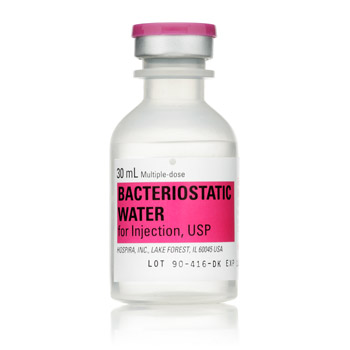
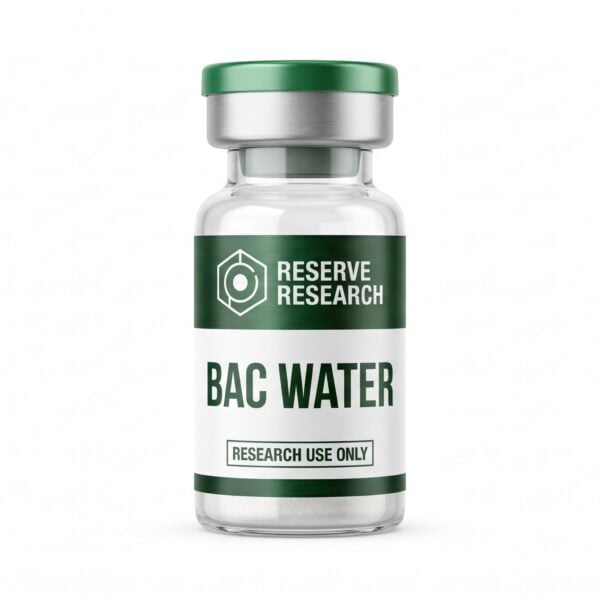
Bacteriostatic water is sterile, USP-grade water preserved with 0.9% benzyl alcohol — a bacteriostatic agent that inhibits microbial growth, so a sealed vial can be accessed repeatedly across a protocol rather than discarded after a single draw. It is the standard diluent for reconstituting lyophilized research peptides. Reserve Research stocks it in multiple vial sizes, third-party verified, with batch-specific documentation on every order. Supplied for laboratory research use only.
Choosing a vial size
— Hospira bacteriostatic water, 30 mL — the reference multi-use presentation, and the format most protocols are written around. Suited to reconstituting several compounds, or to longer runs drawn from one sealed vial.
— Bacteriostatic water, 3 mL — a single-compound format for bringing one lyophilized vial into solution without opening a larger vial.
Specifications
— Composition: sterile, USP-grade water with 0.9% (9 mg/mL) benzyl alcohol as a bacteriostatic preservative
— Appearance: clear, colorless solution
— Presentation: sealed multi-use vial
— Storage: controlled room temperature, 20–25 °C (68–77 °F). Do not freeze. Keep the stopper sealed and protected from light.
— After first access: the benzyl alcohol content is what permits repeated draws from a sealed vial. Standard USP labeling specifies discarding the vial 28 days after it is first accessed.
Bacteriostatic water vs. preservative-free sterile water
The two are not interchangeable. Preservative-free sterile water contains no bacteriostatic agent — once the seal is broken, the contents are intended for a single use and any remainder is discarded. The 0.9% benzyl alcohol in bacteriostatic water suppresses microbial growth between draws, which is why it is the usual choice for reconstituting a peptide that will be sampled across a series of experiments rather than used in one preparation. Where a protocol specifies a preservative-free diluent, bacteriostatic water is not a substitute.
Reconstitution
Lyophilized peptides are brought into solution by introducing diluent slowly down the inner wall of the vial rather than directly onto the powder, then allowing the material to dissolve without agitation. Swirling is preferred to shaking, which can shear peptide chains. Reconstitution volume determines working concentration and is set by the protocol, not by the vial size — a larger diluent vial simply means fewer vials opened across a run.
Certificates of analysis
Every batch ships with batch-specific documentation, and any COA can be checked against the batch number printed on the vial through our COA verification page. The same applies across our compound range: purity by HPLC-UV, identity by LC-MS, endotoxin by LAL, and moisture by Karl Fischer.
Common questions
Is bacteriostatic water the same as bacteriostatic sodium chloride?
No. Bacteriostatic sodium chloride is a preserved saline solution; bacteriostatic water contains no sodium chloride. Protocols specify one or the other and they are not interchangeable.
Why a 30 mL vial when a protocol needs only a few millilitres?
The multi-use format exists precisely so one sealed vial can serve many reconstitutions. The preservative is what makes that possible.
Does it need refrigeration?
No. Bacteriostatic water is stored at controlled room temperature. Reconstituted peptide solutions have their own storage requirements, which are compound-specific.
What does “0.9% benzyl alcohol” mean?
9 mg of benzyl alcohol per millilitre of water — the bacteriostatic agent, at the concentration specified by USP for this preparation.
Research use only
All products supplied by Reserve Research, bacteriostatic water included, are sold strictly for in-vitro laboratory research. They are not drugs, are not for human or veterinary use, and are not intended to diagnose, treat, cure or prevent any disease. See our Compliance & RUO Policy.